Feb 3, 2026
In digital marketing, few metrics are as widely cited—or as narrowly interpreted—as the LTV:CAC ratio. The conventional benchmark is familiar: a ratio of roughly 3:1 is considered healthy, signaling that each customer generates meaningfully more value than their acquisition cost.
Taken in isolation, the ratio appears sufficient. But ratios measure magnitude, not timing. And in operating businesses, timing is decisive.
A company can look profitable in a model while remaining structurally fragile in reality. The reason is simple: revenue that arrives too slowly cannot finance growth, regardless of how attractive the long-term projections appear.
Consider a simplified illustration.
A company acquires customers for approximately $7,500 each and forecasts a lifetime value of $25,000 per customer. On paper, the unit economics look attractive. The ratio clears common benchmarks comfortably. But if the acquisition cost is only recovered after 20 months, the practical implications shift dramatically.
Scaling now requires substantial capital long before any returns are realized. Acquiring 150 customers requires more than $1.1 million in upfront spend. During the recovery window, the business must continue funding payroll, product development, infrastructure, customer success, and ongoing acquisition—while managing churn, pricing pressure, and changes in customer behavior.
The longer the payback period, the more assumptions must hold for the original LTV forecast to remain valid. Retention must persist. Margins must remain stable. Acquisition efficiency must not degrade. As discussed in our prior work on margin of safety, shorter CAC payback periods function as a structural buffer against uncertainty by reducing the number of variables that must cooperate over time.
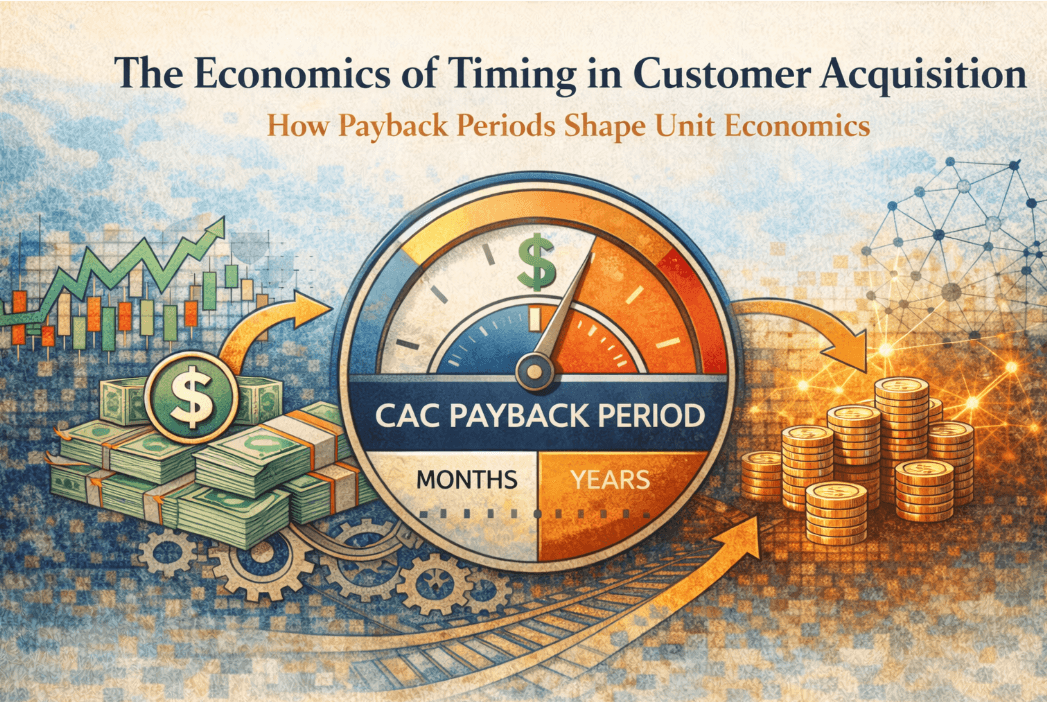
This is why CAC payback functions as a constraint, not a secondary metric. It determines how quickly capital can be recycled back into growth. When payback is slow, expansion becomes dependent on external financing or large cash reserves. When payback is fast, growth becomes internally funded and materially more resilient.
Investors understand this dynamic. Strong unit economics are not defined by a single ratio, but by the alignment of several factors:
A durable LTV:CAC ratio that remains attractive under conservative assumptions
A CAC payback period measured in months rather than years
Gross margins sufficient to absorb churn, variance, and experimentation
When these elements align, scale is mechanically achievable. When they do not, growth becomes increasingly sensitive to shocks—pricing compression, retention slippage, or shifts in channel performance.
The inverse scenario highlights why payback speed is so powerful.
In an illustrative case, a subscription business drives acquisition costs down to roughly $60 per customer through focused targeting and disciplined creative execution. First-year contribution margin covers the majority of acquisition spend, with full payback achieved well before the end of the first year. Retained customers generate incremental value in subsequent periods, even under discounted pricing assumptions.
The absolute lifetime value still matters. But the defining characteristic is immediacy. Capital returns quickly, enabling reinvestment, faster iteration, and compounding without prolonged exposure to cash-flow risk.
This is the difference between theoretical profitability and operational sustainability.
Fast CAC recovery does more than improve spreadsheets. It shortens feedback loops, reduces reliance on financing, and creates strategic flexibility. It allows businesses to adjust in real time rather than defend multi-year assumptions as conditions change.
For this reason, CAC payback should be treated as a primary design variable, not an afterthought. When recovery is delayed, the appropriate response is structural—adjusting targeting, pricing, channel mix, or creative efficiency to compress timelines.
Ultimately, businesses are constrained not by the size of their projected returns, but by how long they must wait to realize them.
Unit economics succeed or fail on timing. Ratios merely describe the outcome.