Jan 2, 2026
The concept of a “margin of safety” — the idea that decisions should be structured to absorb uncertainty and error — was first formally introduced by Ben Graham and David Dodd in the 1930s, in their landmark book Security Analysis. Seth Klarman’s modern book Margin of Safety popularized the principle for contemporary investors, emphasizing disciplined decision-making and risk management.
Though rooted in investing, the principle applies broadly to growth systems: as complexity rises, outcomes must remain interpretable even under imperfect conditions. It is not about pessimism. It is about structure.
It is about clarity under variance.
Growth as a Systems Discipline
Growth is often discussed in terms of tactics or execution. In practice, it behaves as a systems problem.
As spend and throughput increase:
Performance variance naturally rises
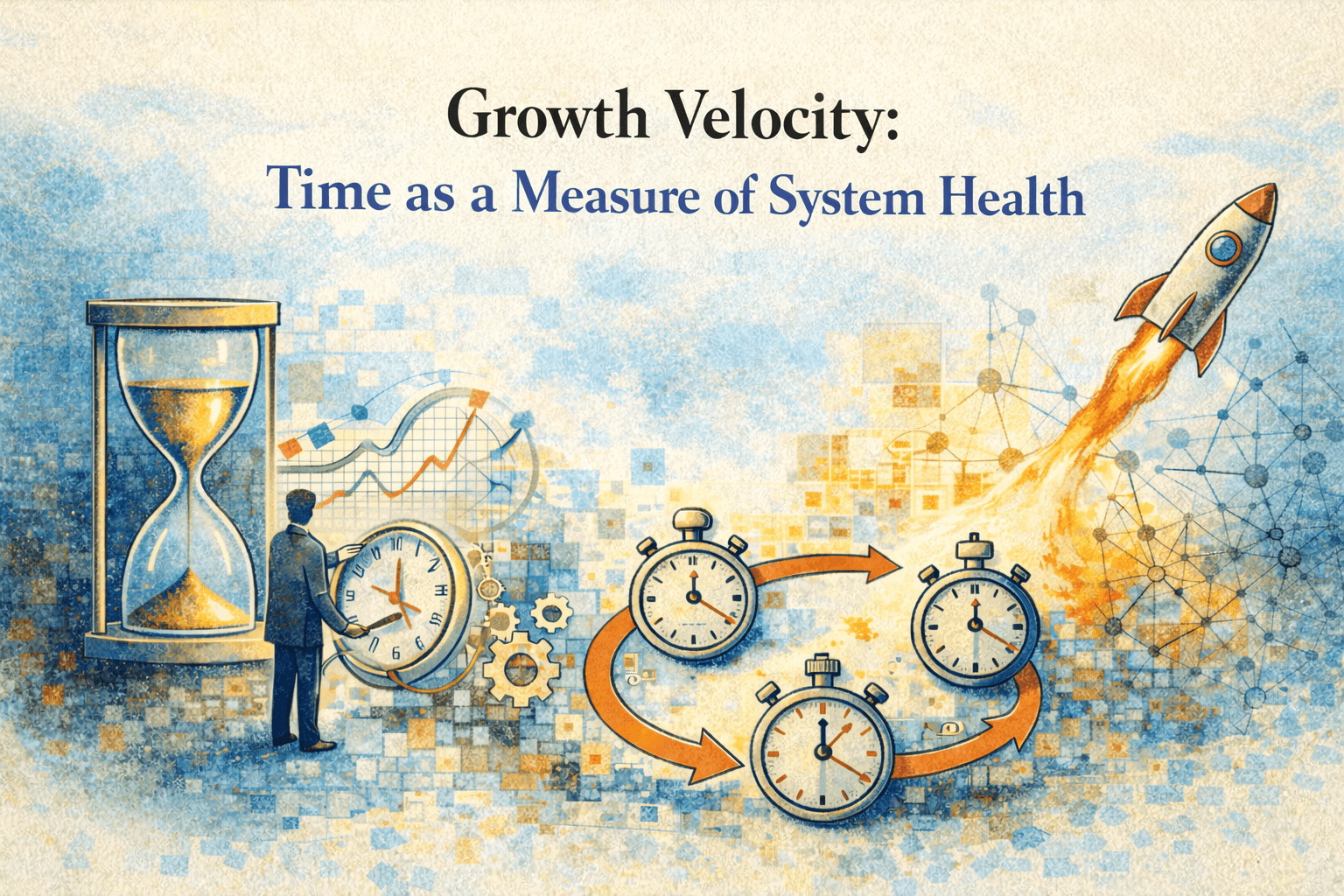
The time required to confidently interpret causal relationships across the system grows, as complexity and noise increase
Small misalignments compound faster, making clarity and structured attribution essential
At scale, growth rarely fails all at once. What erodes first is clarity — clarity about which inputs drive outcomes and under what conditions those relationships hold.
When causality becomes difficult to interpret, scaling decisions are made with incomplete feedback, limiting the confidence of system expansion. Margin of safety in growth is created by designing systems that preserve clarity as complexity increases — preparing for error before it occurs.
What Margin of Safety Looks Like in Growth Systems
In investing, margin of safety is created by buying below intrinsic value. In growth systems, a comparable approach relies on structural safeguards:
Conservative unit economics
Repeatable acquisition paths
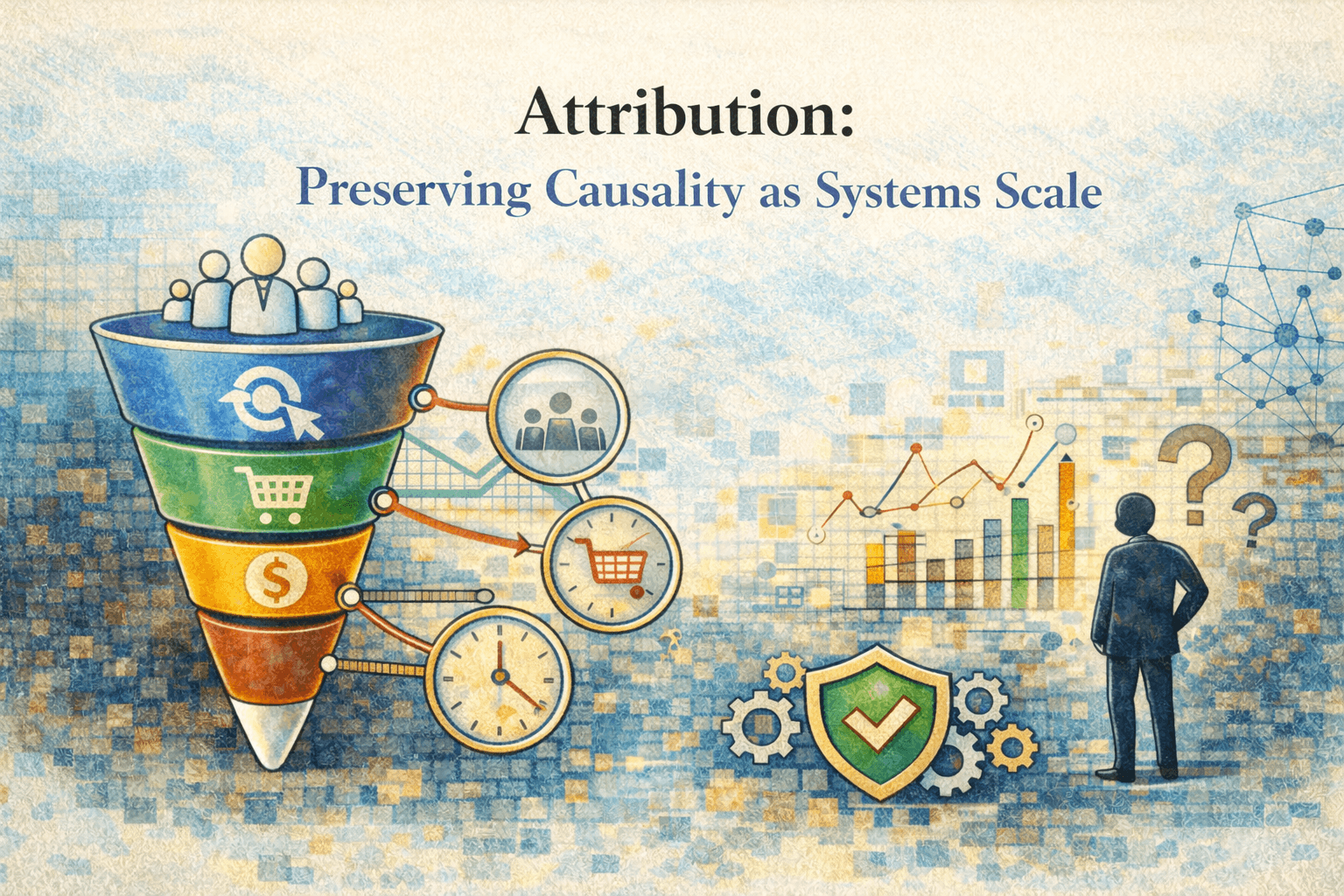
Tight attribution across the funnel
A growth engine with margin of safety does not rely on perfect execution or stable conditions. It tolerates:
Performance variation
Creative fatigue
Channel shifts
Human error
The system continues to function even when assumptions are wrong.
Attribution as a Structural Input
At Kruzeniski Digital, attribution is treated as a structural input, not a retrospective output.
Attribution defines how clearly cause and effect can be observed within a system. That clarity determines how confidently decisions can be made as volume increases.
When attribution is tight:
Customer acquisition costs remain interpretable
Funnel stages remain distinct
Resource allocation remains grounded in observable outcomes
Attribution does not merely describe performance. It constrains uncertainty before it compounds, enabling deliberate, rather than reactive, adjustments.
Instrumenting Intent Across the Funnel
Durable growth systems are built by instrumenting intent at each stage of the customer journey.
Each stage carries a distinct economic signal:
Early-stage curiosity (e.g., content engagement, site visits)
Mid-funnel commitment (e.g., email opens, clicks, trial activations)
Late-stage conviction (e.g., purchase, subscription, conversion)
When signals are mapped to real economic outcomes, attribution becomes deterministic rather than probabilistic. Outcomes are recorded as the system operates, not inferred after the fact. This shortens the feedback loop — a prerequisite for scalable growth.
Applying Margin of Safety to High-Throughput Campaigns
In a recent multi-channel engagement, our team scaled paid acquisition, partnership channels, and mid-funnel email sequences simultaneously. Spend and throughput were increasing rapidly, and complexity compounded naturally.
To preserve margin of safety:
Conservative LTV modeling: We projected lifetime value under multiple retention and discount scenarios, establishing boundaries for safe scaling.
Stage-level attribution: Every channel and funnel stage was instrumented so that revenue and engagement could be directly observed, ensuring decisions were grounded in clear causality.
Channel diversification: Paid ads, partnerships, and email sequences acted as structural risk buffers, reducing reliance on any single tactic.
The results demonstrate the value of structural clarity: immediate revenue covered a significant portion of spend, while lifetime value projections indicated more than double return over multiple years. Even under natural performance variance, the system’s design allowed deliberate adjustments without restarting or destabilizing operations.
Attribution as a Margin of Safety Multiplier
Clear attribution preserves interpretability as systems scale.
Performance naturally varies across days, channels, and cohorts. When attribution is explicit, those variations are evaluated in context rather than reacted to in isolation. This enables systems to be adjusted deliberately instead of reset prematurely.
Margin of safety, in this sense, is not about avoiding variation. It is about maintaining visibility into what that variation represents.
Conservative Economics and Structural Clarity
Conservative unit economics define the boundaries within which a growth system can operate. Attribution defines how the system operates within those boundaries.
Without attribution clarity, even conservative assumptions lose effectiveness. With it, systems can expand while remaining intelligible. Margin of safety emerges when economics and attribution reinforce one another — when downside is bounded and causality remains visible.
Growth Engines That Endure
Growth systems are stressed as they scale — through shifting channels, uneven performance, and increasing complexity.
The systems that endure are those that retain explanatory clarity under stress.
At Kruzeniski Digital, margin of safety is not a constraint on growth. It is the discipline that allows growth to scale without fragility. It is the difference between systems that require ideal conditions and systems that continue to function as conditions change.