Jan 2, 2026
At scale, growth becomes difficult to interpret.
As volume increases, signals overlap. Time horizons extend. Outcomes lag inputs. The relationship between action and result becomes less direct.
This is not a failure of effort or execution. It is a natural property of complex systems.
At Kruzeniski Digital, attribution is treated as a structural concern — not because it explains results after the fact, but because it preserves causality as systems grow.
Attribution as a Structural Property
Attribution defines how clearly cause and effect can be observed within a system.
When that relationship is clear, decisions can be made with confidence even as conditions change. When it becomes ambiguous, uncertainty compounds alongside spend and throughput.
Growth rarely breaks all at once.
What degrades first is interpretability.
Attribution, in this sense, is not descriptive. It is protective.
Designing for Causality, Not Retrospection
Attribution is most durable when it is designed into the system rather than inferred afterward.
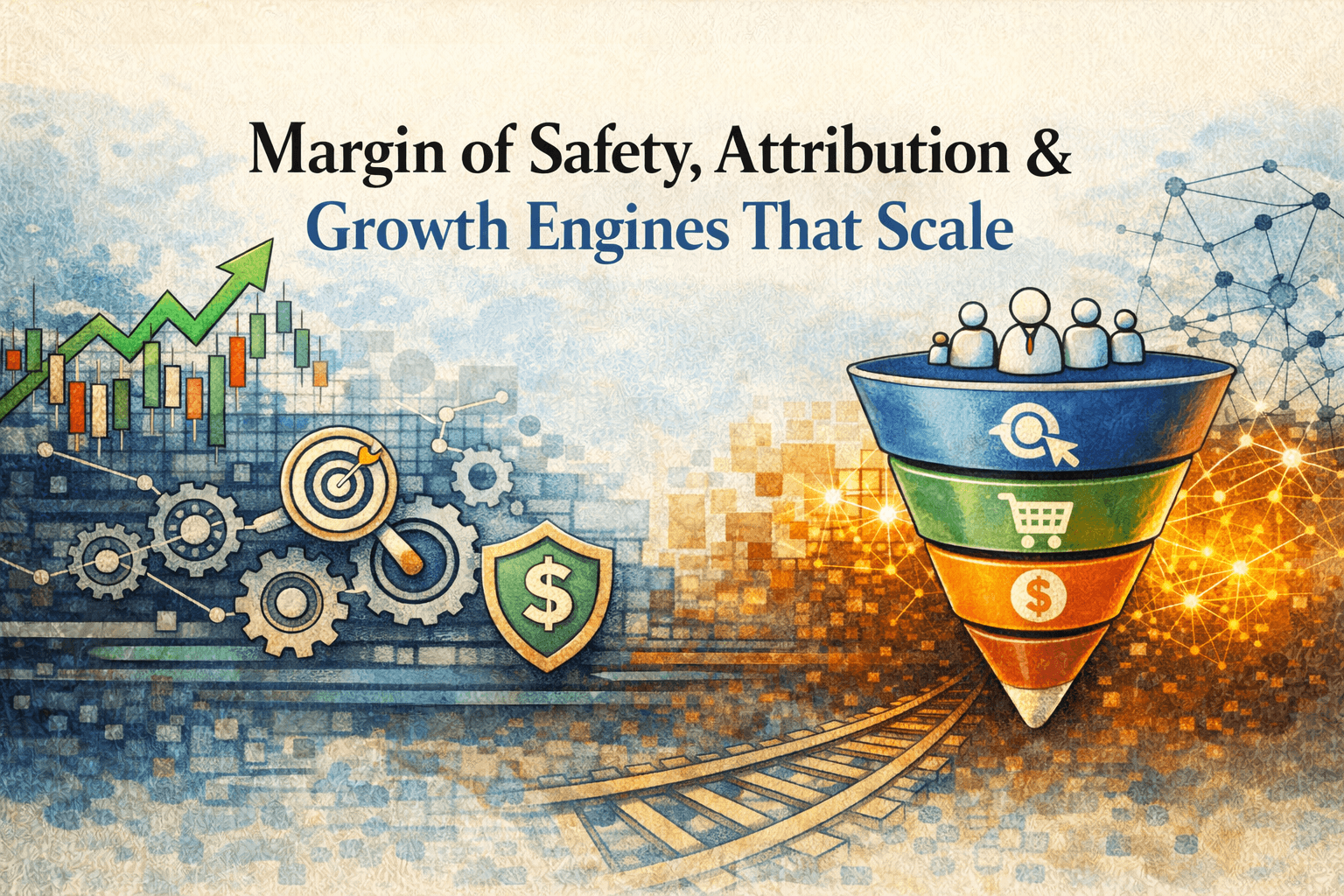
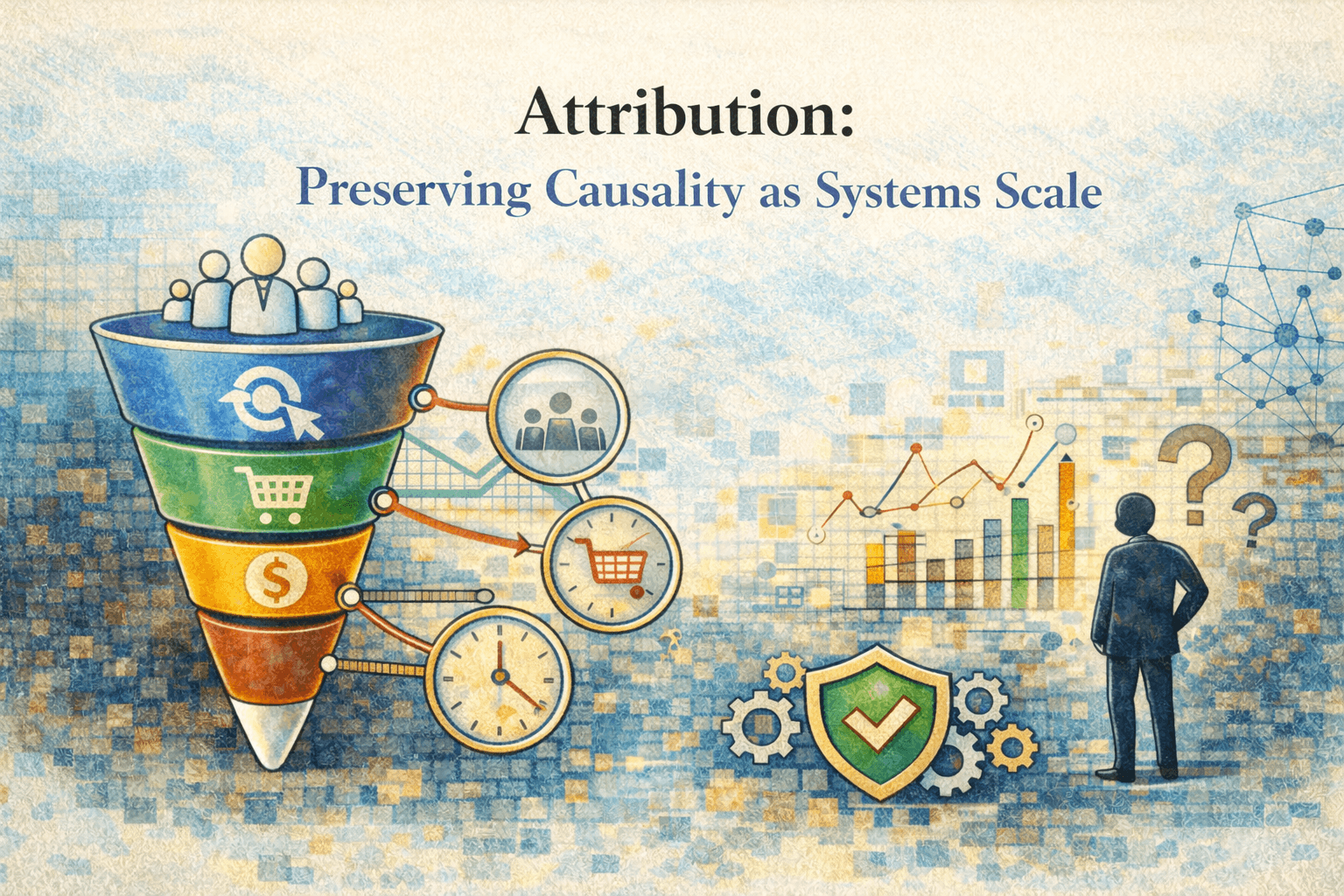
Each stage of the funnel is treated as a discrete economic event, not as part of a blended narrative:
Early activity reflects curiosity
Mid-stage behavior reflects engagement
Late-stage actions reflect conviction
When these stages are instrumented distinctly, outcomes arrive with context intact. Causality is recorded as the system operates rather than reconstructed later.
This reduces reliance on interpretation and shortens the distance between decision and evidence.
Preserving Interpretability Under Load
As throughput increases, variation becomes inevitable.
Performance shifts across days, channels, and cohorts. Creative effectiveness changes. External conditions fluctuate. None of this is abnormal.
Clear attribution allows these changes to be evaluated in relation to known inputs rather than reacted to in isolation.
Instead of asking whether something is working, the system can reveal under which conditions it works.
Attribution does not eliminate uncertainty.
It bounds it.
And bounded uncertainty is what allows growth systems to expand without losing coherence.